
pg_tre: approximate regex as a real Postgres index AM.
PostgreSQL ships excellent text-search primitives. pg_trgm gives
you trigram similarity and accelerated LIKE. The built-in
full-text-search machinery (tsvector/tsquery) gives you
linguistic search with stemming, stopwords, and ranking. pgvector
and friends give you semantic similarity over embeddings. Each is
strong at the thing it was built for.
What none of them do is approximate regular expression matching
through an index. The query "find rows whose body matches this
regex within k edits" — the ripgrep-with--z shape — is not
something the existing extensions can answer with index acceleration.
pg_tre is the index access
method that fills that gap.
what approximate regex actually means
Most people who say "regex" mean PCRE-like patterns: character classes, alternation, anchors, repetition, capturing groups. The standard semantics are exact: a string either matches the pattern or does not.
Approximate regex extends the model with an edit budget. The
operator I use, borrowed from
Ville Laurikari's TRE library,
attaches a {~k} count to a sub-expression and asks "match within at
most k insertions, deletions, or substitutions." The full
expression composes those budgets:
-- "approximately the word `error` (one edit allowed)
--  followed by anything followed by the literal 42x range
--  (zero edits allowed)", overall edit budget 1.
SELECT id
FROM   docs
WHERE  body %~~ tre_pattern('(error){~1}.*(42[0-9]){~0}', 1);
This is the operator nobody else in the Postgres extension ecosystem exposes through an index, and it is exactly the shape log-analytics and code-search workloads need.
why a real index AM and not a UDF
The lazy way to ship this would be a tre_amatch(text, pattern, k)
function and tell people to add it to a WHERE clause. That works
for tens of rows. It does not work for millions, because the planner
has no way to avoid the heap scan: every row has to be loaded and
the function evaluated on its body.
A real index AM lets the planner avoid the heap scan when the index
can prove a row cannot match. pg_tre registers
IndexAmRoutine under the name tre, owns rmgr id 140 for WAL
coverage, supports REINDEX CONCURRENTLY, integrates with VACUUM,
and survives crash recovery and streaming replication the same way
btree does. None of that is glamorous; all of it is what an index
AM has to do to be a first-class citizen.
the three-tier filter funnel
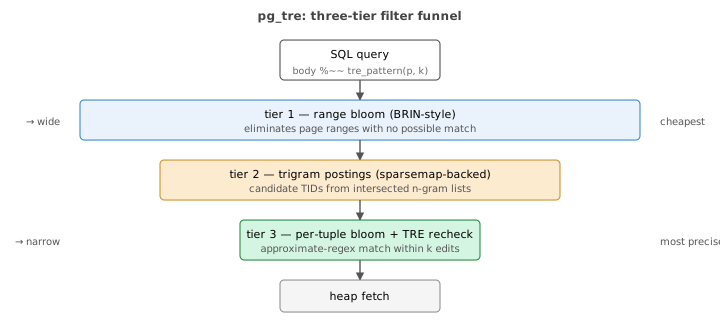
The hard problem is making the index fast. Approximate regex matching is intrinsically expensive: the NFA simulation has a state space that grows with the edit budget, so you cannot afford to run it on every candidate row. The architecture is a funnel of cheap- to-expensive filters, each more precise than the last:
-
Tier 1 — range bloom. A BRIN-style summary per page range asks "does this page range contain any trigram from the pattern's required set?" When the answer is no, the entire page range is skipped without a heap fetch. Cheap, broad, eliminates most of the table on selective queries.
-
Tier 2 — trigram postings. A trigram inverted index where the postings layer is
sparsemap, not GIN's array-of-itempointers. The intersection of the required-trigram postings produces the candidate TID set. Sparsemap is the right substrate here because trigram postings in real corpora hit its best case — long runs of contiguous TIDs, because rows that share a trigram cluster on disk. -
Tier 3 — per-tuple bloom + TRE recheck. A small bloom filter per indexed tuple eliminates obvious non-matches in constant time. Survivors are handed to the TRE library for the full Levenshtein-distance recheck against the pattern.
The three tiers compose so that the executor never reads the heap for rows that earlier tiers have eliminated. On the queries that return a handful of rows out of millions, the result is sub- millisecond latency.
what makes it fit into PostgreSQL cleanly
A custom index AM is an awkward thing to ship. It can break in
ways btree cannot, because nothing else has trodden the path. Three
properties matter for being able to deploy pg_tre in production
the way you would deploy btree_gin:
-
Custom rmgr (id 140) with full WAL coverage. Every change to the index is journalled and replayed; crash recovery and streaming replication just work. Validated by TAP tests.
-
DoS protection by construction. Configurable caps on NFA state count, compile time, and per-match runtime mean a pathological pattern cannot stall the executor indefinitely. The defaults are tuned for log-analytics shapes.
-
UTF-8 codepoint trigrams, not byte trigrams. CJK, accented characters, and emoji index correctly; ASCII pays zero overhead. The trigram extraction is done at the codepoint level so a trigram never spans a UTF-8 continuation byte.
where pg_tre sits next to what you already have
pg_tre is meant to complement the existing search extensions, not replace them.
-
pg_trgm(GIN/GiST) is the right tool for exact regex,LIKE, and trigram-set similarity.pg_trgm %is Jaccard similarity over trigram sets, which is not the same as edit distance — two strings with overlapping trigrams can score "similar" even when their Levenshtein distance is huge. Usepg_trgmwhen you need exact-substring orLIKEacceleration. -
tsvector/tsqueryis the right tool for natural-language prose, where stemming and stopwords matter. pg_tre is language-agnostic, which is a feature for identifiers, SKUs, error codes, and log lines, and a non-feature for "running" matching "run". -
pgvector/pgvectorscaleis the right tool for semantic similarity over embeddings. Orthogonal to pg_tre — meaning vs. lexical structure. The two compose naturally as a hybrid filter: pre-filter lexically with pg_tre, rank semantically with pgvector. -
pg_treis the right tool for approximate regex with explicit edit budgets and full regex semantics composable with the{~k}operator. Nothing else in the ecosystem answers the same question through an index.
a few things only pg_tre does well
Not every query has an answer in approximate regex. The shapes where pg_tre is the right tool are specific:
- Log-analytics queries against unstructured payloads where the pattern was typed by an operator under time pressure and contains typos.
- Code-search queries with planned wildcards plus tolerated
edits ("find calls to
*_alloc(...)with one edit"). - Identifier search across heterogeneous corpora where the spelling is unstable (drug names, gene symbols, error codes, SKU prefixes).
- Anything where you have been writing custom Python with
regex.findallplusLevenshtein.distanceand want it to be a single SQL predicate.
status
v1.1.1. Same on-disk format as 1.0.0 and 1.1.0; no re-index
required between versions. MIT-licensed. Built against
PostgreSQL 18, but the AM design is forward-compatible. Tested on
real corpora — Postgres archives, dbpedia, a sample of the Linux
kernel mailing-list — and the numbers in
bench/
are repeatable.
The pattern parser is built on Lime, my runtime-extensible LALR(1) parser generator; that is its own post. The repo is at https://codeberg.org/gregburd/pg_tre with a GitHub mirror.